
Silkothane®, a hybrid material for vascular access
Biocompatible silk fibroin combined with a medical-grade, implantable polycarbonate-urethane, electrospun into a graft wall the body can grow into.
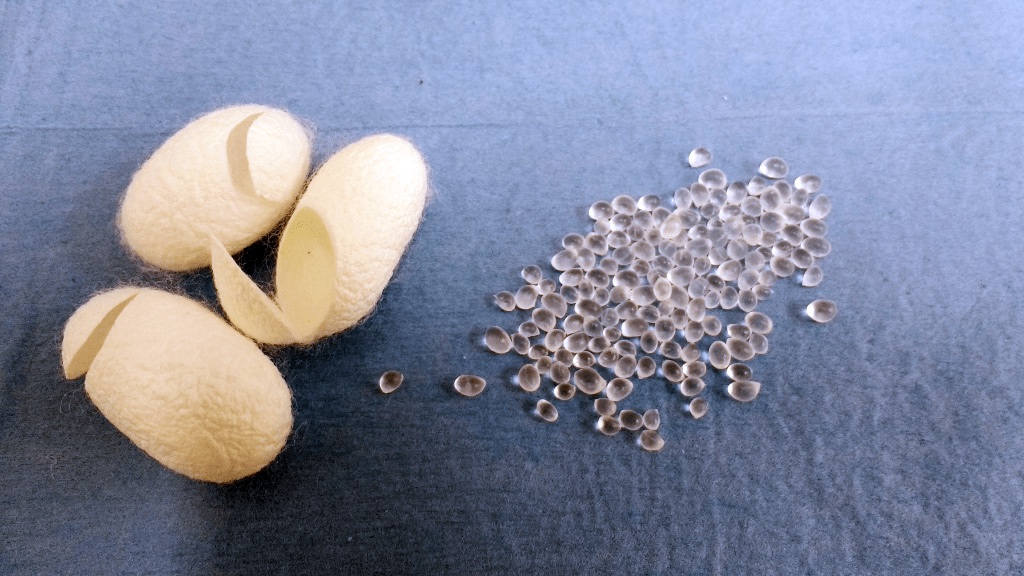
Two polymers, chosen for what each does best
Silk fibroin brings biocompatibility and the ability to be remodelled. Host cells adhere to it and, over time, reshape its fibres.
Polyurethane brings elasticity and stability. A thin polyurethane mesh stays in place and keeps the graft strong.
Electrospun meshes can be made in different formulations. In tensile tests the Young's modulus ranged from about 4 MPa (75% polyurethane) to 23 MPa (75% silk fibroin).
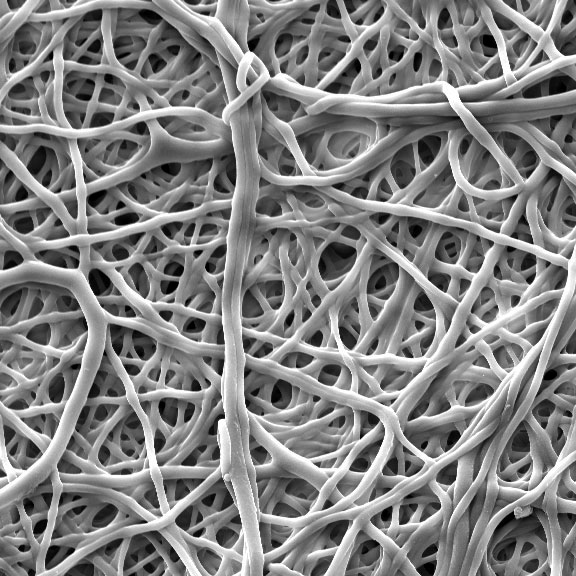
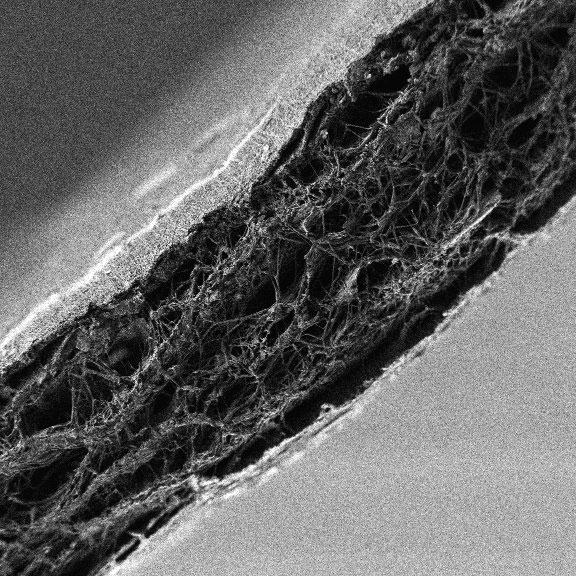
A three-layered, semi-resorbable graft
Electrospinning applies an electric field to a polymer solution delivered by a syringe pump, producing porous nano-fibrous scaffolds that resemble the native extracellular matrix.
The Silkothane® Arteriovenous Graft uses this structure for in situ tissue engineering: host cells colonise and remodel the graft after implantation.
- Designed to be available off the shelf
- Designed for cannulation within 48 hours
- Designed for hemocompatibility and host integration
Publications
- A novel hybrid silk-fibroin/polyurethane three-layered vascular graft: towards in situ tissue-engineered vascular accesses for haemodialysisvan Uden S, et al. Biomed Mater. 2019;14(2):025007. PubMed
- A Novel Hybrid Silk Fibroin/Polyurethane Arteriovenous Graft for Hemodialysis: Proof-of-Concept Animal Study in an Ovine ModelRiboldi SA, Tozzi M, et al. Adv Healthc Mater. 2020;9(20):e2000794. PubMed
- Electrospun fibroin/polyurethane hybrid meshes: Manufacturing, characterization, and potentialities as substrates for haemodialysis arteriovenous graftsvan Uden S, et al. J Biomed Mater Res B Appl Biomater. 2019;107(3):807-817. PubMed